Beyond English: Building Multilingual Captions for Medical Videos the Right Way
A cardiology fellow in Lima. A nursing student in Manila. A patient in Miami whose first language is Spanish. The same instructional video can serve all three—if the captions meet them where they are.
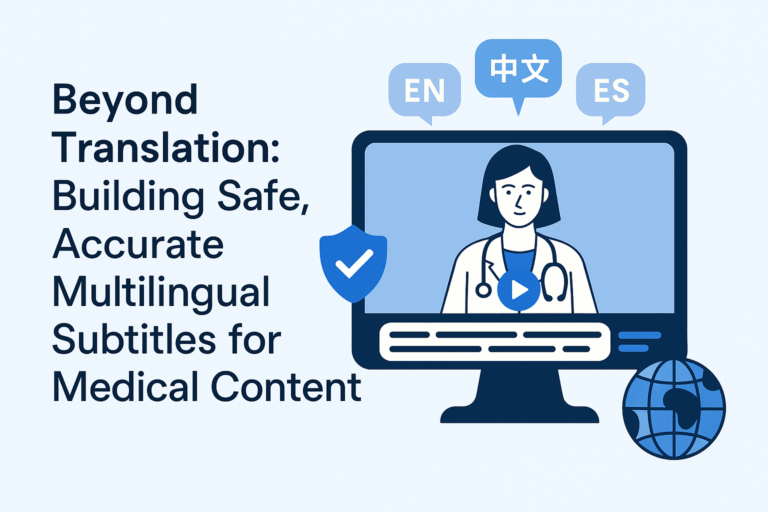
In medicine, a small mistranslation can be a big problem. “Lead” vs “lid,” “ileus” vs “IUD,” “mg” vs “mcg”—we’ve all seen how fast it can go wrong. That’s why multilingual captions for medical content require more than a quick auto-translate. They demand a clinical mindset, a solid workflow, and tools tuned for medical language.
Why multilingual captions matter
Education without borders: Conferences, grand rounds, and CME content reach a global audience. Accurate captions boost comprehension for non-native English speakers and improve retention for everyone.
Patient safety and equity: Captions make procedural videos, patient education, and discharge instructions more accessible across languages, hearing abilities, and learning styles.
Compliance and professionalism: Many institutions aim to meet accessibility standards and language access policies. Good captions are part of responsible, inclusive care and training.
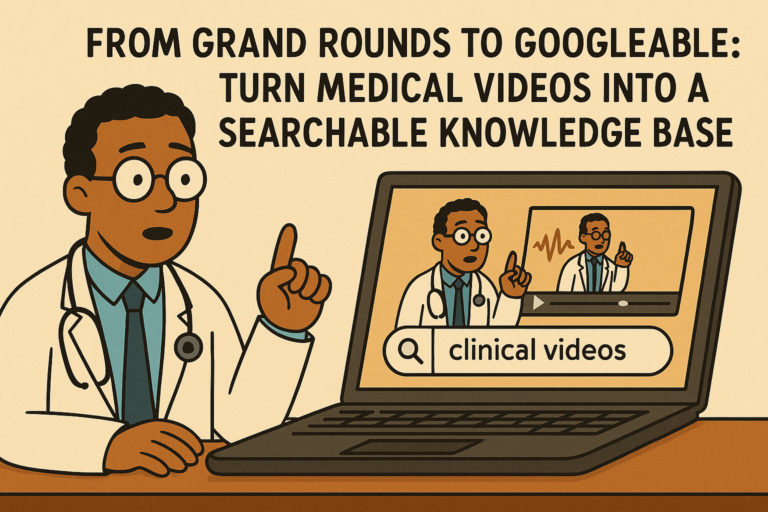
Discoverability and engagement: Searchable, captioned videos rank better and keep viewers watching longer.
A practical workflow that protects accuracy
1) Start with clean audio
– Use a good mic, reduce background noise, and ask speakers to state key terms clearly (“metoprolol—M-E-T-O-P-R-O-L-O-L”). Better audio equals better source captions.
2) Create a high-fidelity source transcript
– Transcribe in the original language first. MedXcribe is fine-tuned on medical data, so the transcription is very accurate with drug names, anatomy, and acronyms.
– Include timestamps, speaker labels (e.g., Attending, Fellow), and non-speech cues (e.g., [alarm beeping]). Closed captions include audio cues; subtitles typically don’t.
3) Lock down terminology before translation
– Build a mini-glossary of critical terms: drugs (generic vs brand), procedures, devices, abbreviations, units. Note what must stay untranslated (e.g., brand names, gene symbols) and preferred translations for everything else.
4) Translate with a medical lens
– Use a translator familiar with clinical content or a translation tool plus human review. Provide the glossary so terms are consistent. If you must move fast, prioritize a bilingual SME review for high-risk segments (medications, dosing, contraindications).
5) Quality assurance by a bilingual clinician
– Have a clinician or trained reviewer spot-check terms, units, and context. Pay attention to dose decimals, contraindications, and similar-sounding terms. Read captions aloud over the video to catch timing or readability issues.
6) Format for readability and languages
– Keep lines under ~42 characters and 1–2 lines per caption.
– Respect reading speed (generally 140–180 words per minute depending on audience).
– Test right-to-left scripts (Arabic, Hebrew), accent marks, and non-Latin characters. Ensure punctuation, line breaks, and directionality render correctly on your platform.
7) Publish with version control
– Save the source transcript and each language version with clear versioning. If you update the video or clinical content, update all languages synchronously.
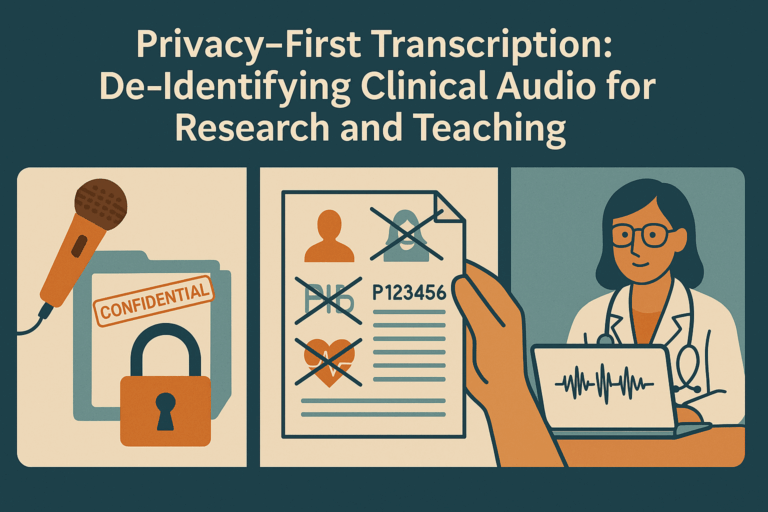
8) Safeguard privacy throughout
– If videos include PHI, de-identify audio and visuals, limit access, and use HIPAA-aligned tools and storage.
Tips, tools, and pitfalls to avoid
Units and decimals: Watch for regional formats (1,5 mg vs 1.5 mg). Lock units in your glossary and specify decimal style.
Brand vs generic: Decide once and stick to it. Many regions prefer generics; some patient materials use brands be deliberate.
Acronyms: Expand on first mention, then use the acronym. Avoid ambiguous acronyms in captions when possible.
Latin abbreviations: Consider translating or expanding (e.g., “q.i.d.” to “four times daily”) to improve safety.
Diarization matters: If multiple speakers alternate, ensure captions preserve who’s speaking vital for case discussions and panel Q&A.
Numbers and ranges: Spell out when safety-critical (“one-point-five milligrams”) to prevent misreadings.
Cultural and regulatory nuance: Some terms and device names vary by region. Validate with local SMEs for patient-facing content.
A quick story from the field
A cardiology program posted a series on ECG interpretation. Their English-only videos earned good feedback but lost viewers during dense segments. They followed the workflow above, using MedXcribe to generate precise, time-coded English captions, built a short terminology list for drugs and intervals (QTc, PR, ST), and worked with bilingual reviewers to produce Spanish, Arabic, and Hindi captions. After launch, average watch time increased by 28%, comment questions shifted from “What did you say here?” to deeper clinical discussion, and their patient-focused module was adopted by partner clinics for language-concordant care.
How MedXcribe fits in
Start strong: Upload your lecture, simulation, or procedure video to MedXcribe to generate accurate, time-stamped source captions. Medical tuning helps with specialty terms right out of the gate.
Customize: Add a custom vocabulary for your specialty—oncology protocols, device names, institutional abbreviations—to further reduce errors.
Export and translate: Export time-coded captions in the format your platform supports (e.g., SRT/VTT). Share the file and glossary with your translator or translation tool, then reimport and preview.
Review and publish: Run a bilingual clinical QA pass, fix timing or line length issues, and publish to your LMS, YouTube, or intranet.
The takeaway
Multilingual captions are not just a courtesy—they’re a clinical quality decision. When you begin with a high-accuracy medical transcript, lock terminology, and apply a thoughtful review, your videos become safer, clearer, and more impactful worldwide.
Ready to see the difference? Try MedXcribe with a 5–10 minute clip, generate your source captions, and build your first multilingual workflow. Your learners—and your patients—will thank you.
Transcribe medical notes offline, on your iPhone
MedXcribe turns dictations and consultations into accurate transcripts and SOAP notes without an internet connection. Your first 25 recordings are free.
Download Transcription App for iPhone